
This article discusses a scam that impersonates FIFA and its official World Cup 2026 branding. FIFA is not involved in the scam, and this article should not be interpreted to state or imply any wrongdoing on their part. The legitimate websites referenced as compromised entry points were injected with fraudulent content without the knowledge or involvement of their owners.
The pitch is too good
The FIFA World Cup 2026 is one of the most-watched sporting events on the planet, and cybercriminals know it. Millions of fans are searching for free live streams right now, and a coordinated criminal operation is ready to meet them in Google search results. The sites eager fans land on look promising, but no streaming content is ever delivered. What arrives instead is a form designed to capture their email address and password. TrendLife researchers uncovered this campaign at the tournament’s opening in June 2026, and it was still active at the time of analysis.
How this scam works, step by step
Step 1: Criminal operators plant fake pages on real websites.
This campaign starts with a technique called SEO poisoning. Search engines rank results partly based on the reputation of the website hosting a page. Criminal operators exploit this by breaking into established, trusted websites and secretly planting FIFA-branded pages inside them. The hidden pages are loaded with keywords designed to surface in search results for terms like “FIFA World Cup 2026 free live stream.” The legitimate site owners have no idea the pages are there. In this campaign, one compromised site belongs to an academic researcher; another belongs to a European household paper brand. Neither has any connection to football broadcasting.
Step 2: The search result is engineered to attract clicks.
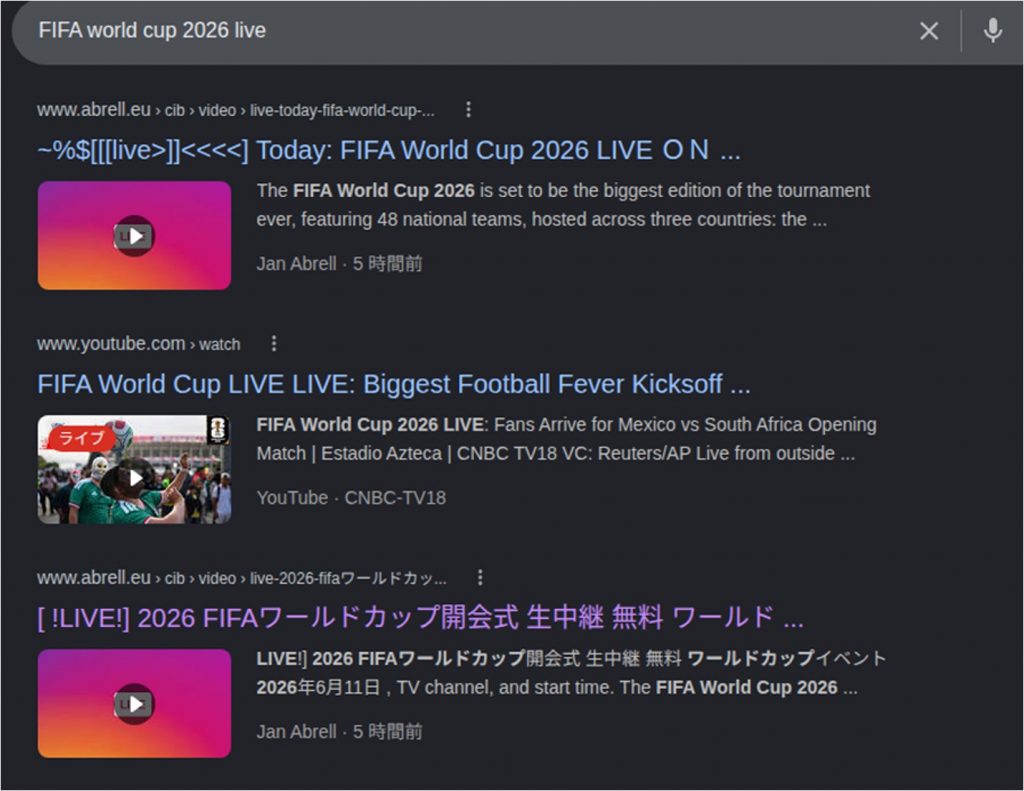
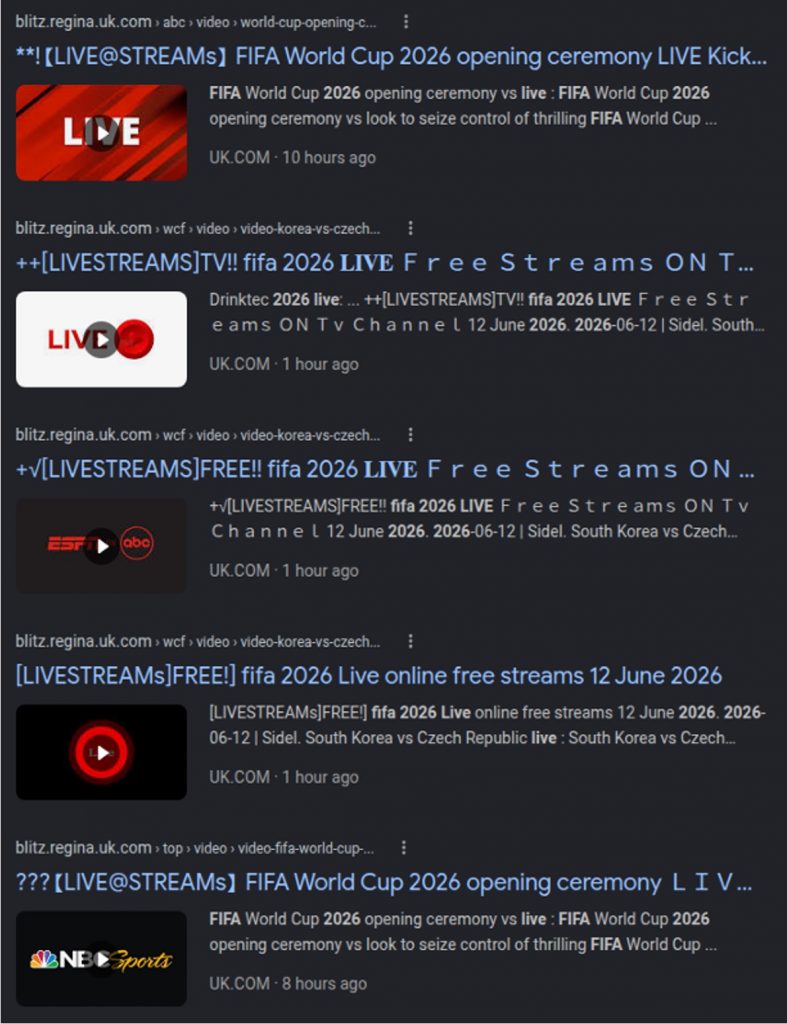
The search engine listings criminal operators create don’t look like a researcher’s site or a paper company. They look like streaming results. The titles are crafted using special character padding, the practice of stuffing brackets, symbols, and punctuation around words to make a listing stand out visually in a results page. Variations observed in this campaign include: [LIVE@STREAMs], ++[LIVESTREAMS]FREE!!, and ~%$[[[live>]]<<<<]. These are not formatting errors or garbled text. A listing cluttered with symbols can be eye catching and register as urgent or exclusive. Fans clicking quickly during a live tournament are exactly the audience this technique is designed to reach.
Step 3: The fake streaming site collects credentials.
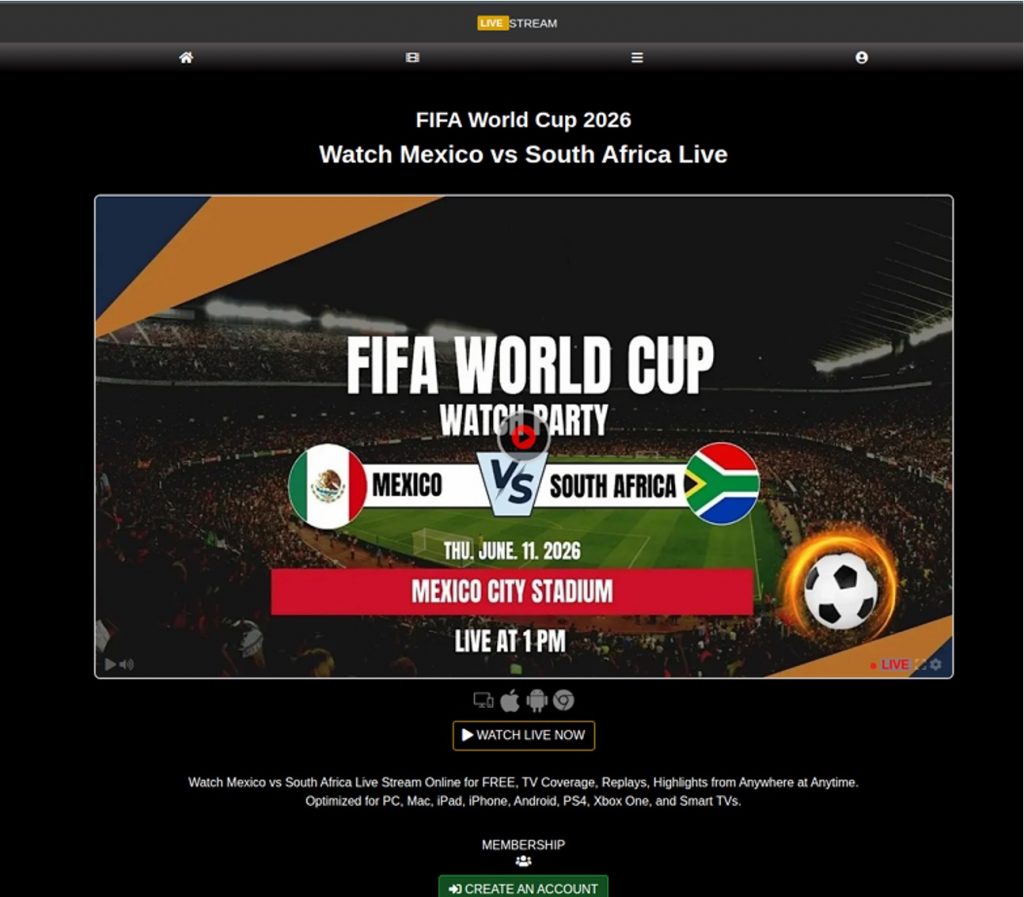
Clicking the result routes the visitor through an affiliate tracking link to one of several fake streaming fronts. Some use identical boilerplate text copied verbatim across multiple sites. One more polished variant uses the official FIFA World Cup 2026 logo and correct tournament dates. No actual video plays on any of them. Every path ends at an account creation form collecting names, emails, and passwords. The stream never materializes because criminals have designed the sign-up form to be the destination.
Step 4: Criminal operators add a second layer of access.
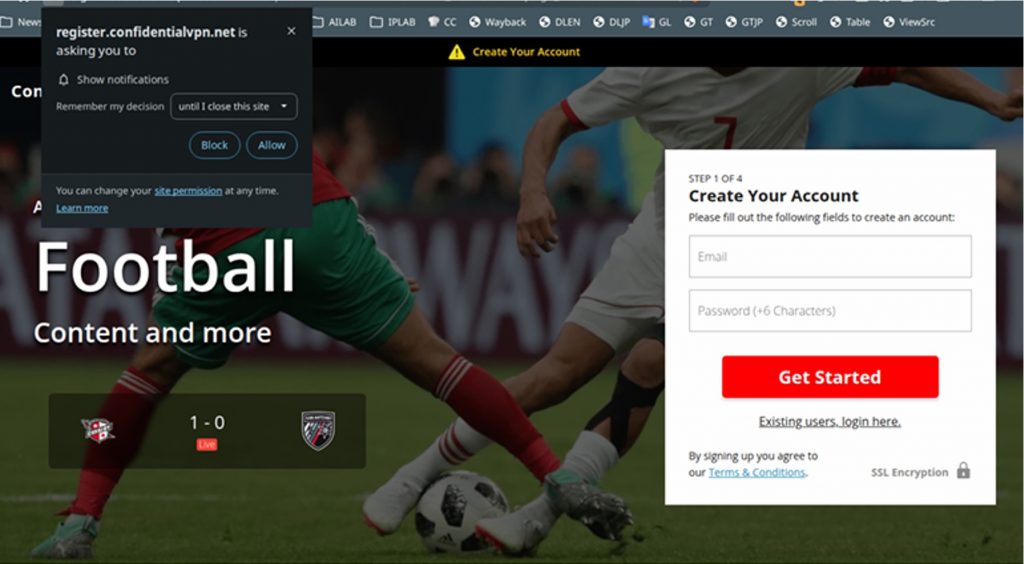
Some redirect chains lead to a fake VPN subscription page. Before or during sign-up, a browser pop-up appears asking whether the site can send notifications to the device. This is the same kind of permission prompt that news sites use to send breaking news alerts. Granting it on a fraudulent site hands criminal operators an ongoing channel to push further scam content directly to the device. The notifications continue even after the browser tab is closed.
What criminal operators gain: Working email and password combinations they can sell, test against other accounts, or use to commit further fraud. The notification permissions are a separate income stream, enabling persistent advertising pushed directly to the device long after the visit ends.
Signs worth pausing on
Legitimate World Cup broadcasters do not require fans to create a new account on an unfamiliar domain to watch matches. That requirement alone is a reliable signal that something is wrong. Here are five more patterns to watch for:
- The domain has no connection to sports. Academic research sites, paper brands, and other unrelated organizations do not broadcast live football. If the URL belongs to a company with no obvious sports affiliation, that is not an accident. It is infrastructure criminal operators chose because the site already had credibility with search engines.
- The search result title uses special character padding. Brackets, symbols, and heavy punctuation crammed into a title are a deliberate technique, not a style choice. Legitimate broadcasters do not title their listings this way.
- The URL contains a typo that mimics a real platform. One fake streaming domain observed in this campaign had an extra letter in it, placed to look like a known, legitimate streaming site at a glance.
- A notification permission prompt appears on a streaming site. If a site you have just arrived on asks to send your browser notifications before you have watched anything or signed up for anything, decline. This permission is not required to stream video.
- The stream never plays. If “Watch Live Now” leads only to account registration, there is no stream. The account creation page is the product.
What you can do
- Go directly to official broadcasters. Search for your country’s official World Cup broadcaster and navigate there directly. Do not rely on search results to find a stream during tournament windows, when criminal operators specifically time their campaigns to appear.
- Check the domain before entering anything. If the URL belongs to an organization with no obvious connection to broadcasting or sports, close the tab.
- Decline notification requests on streaming sites. There is no legitimate reason a streaming service needs to push notifications to your browser before you have signed in or started watching.
- Use unique passwords for every account. If the same password is used across multiple accounts and criminal operators capture it through a fake form, every account that shares that password is at risk, not just the one created on the fraudulent site. A password manager makes maintaining unique passwords straightforward.
- Check a link with ScamCheck before clicking. The Trend Micro ScamCheck tool can assess whether a URL is fraudulent before you visit it, so you know what a link leads to without having to find out firsthand.
The scale of this operation
This campaign is larger than any single fan’s search for a free stream. TrendLife researchers found that the same compromised websites hosting fake FIFA pages were simultaneously running entirely separate fraudulent operations, suggesting automated mass injection rather than anything hand-built or targeted. The FIFA campaign itself was constructed in multiple languages, with streaming pages in English, Italian, and Japanese found on the same compromised infrastructure, each using locally relevant search terms designed to surface in results for fans in those countries. Criminal operators are not targeting one audience. They are running a multilingual, multi-operation campaign designed to capture as many people as possible, in as many countries as possible, during the narrow window when World Cup search traffic is at its peak.
You already know what to look for
Criminal operators invest considerable effort in making these sites look convincing. But knowing the patterns they rely on changes what you see in a results page. Before clicking a streaming link, take a moment to check where it actually leads. When in doubt, go straight to a broadcaster you already know and trust. And if you found this useful, share it. Passing this on is a practical way to help.
0 Comments
Other Topics
You Might Also Be Interested In...


