
Last Updated on Oct 7, 2026
This article discusses scams that impersonate Amazon, FedEx, USPS, Evri, Royal Mail, and DPD. None of these companies or their services are involved in the scams. All brand names are trademarks of their respective owners.
A text offers a work-from-home job through “Amazon’s HR team,” paying $250 to $500 a day. Another claims a package couldn’t be delivered and needs your address confirmed before a deadline. Neither is real, and neither is rare. Amazon’s October sale event, Prime Big Deal Days, starts this week, and TrendLife’s analysis shows a wave of Amazon-themed scams already building around it.
Scam activity is already climbing
Amazon-themed scam URLs spiked before Prime Big Deal Days. TrendLife tracked these across the US and UK through June. In the US, 84% of the Amazon-related scam URLs TrendLife tracked showed up in the two weeks before the event. In the UK, it was 89%. In each market, that pre-event surge hit in a single day, not a steady buildup, suggesting scammers sent these out in one coordinated push. By the time the event itself started, activity in both countries had already dropped back toward June’s baseline levels.
Beyond scam links, three kinds of messages make up the most common, easiest-to-recognize version of this activity: fake Amazon job offers, fake delivery alerts, and phishing emails about your Prime membership. Here’s how each one works and how to tell it apart from the real thing.
Scam 1: Fake Amazon job offers
1. A text claims to be from Amazon’s HR team with an urgent opening
“Hello! Camila from Amazon’s HR Team here. We’ve reviewed your profile and believe you’d excel in our effortless work-from-home role… Compensation: $250-$500 daily ($1,000 base pay per 4 working days)… Only 20 openings left for candidates 20+ years old.” These texts didn’t wait for the event to start. About 28% of the fake job offer texts TrendLife tracked in June landed in the single week before Prime Big Deal Days. During the four-day event itself, the daily volume roughly doubled compared to June’s overall average. That timing lines up with when Amazon’s own hiring push would be most visible, which is exactly what makes the offer convincing.
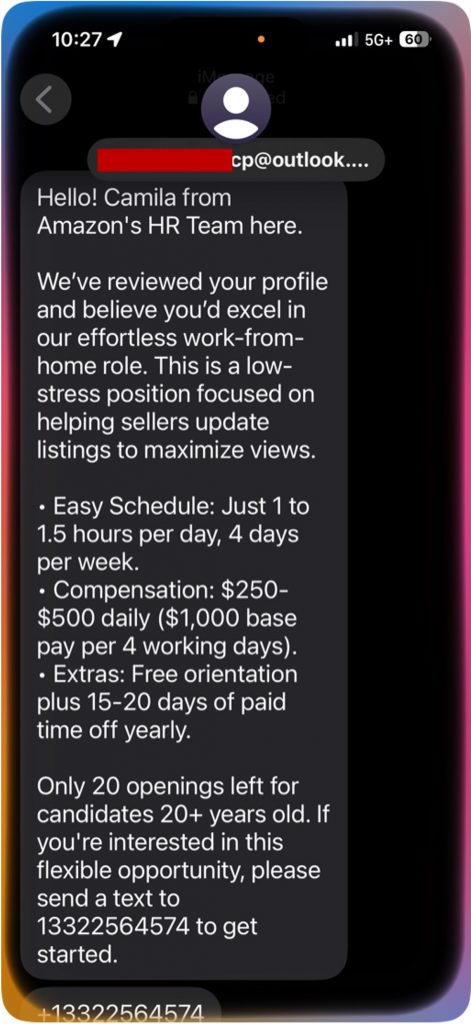
2. Replying moves the conversation to WhatsApp or Telegram
Once you reply, the conversation shifts off your phone’s regular messaging app to WhatsApp or Telegram. The “recruiter” lays out a task-based job: simple data entry or product review tasks, paid per task completed.
3. “Unlocking” your pay requires a deposit first
Eventually, you’re told your earnings are ready but a deposit is required to “unlock” the balance or cover a processing fee. There’s no job and no pay behind it. The deposit is the entire point of the scam.
Scam 2: Fake delivery texts
1. A text claims a package couldn’t be delivered, naming a carrier you actually use
As a sale event wraps and real packages start shipping, texts impersonating FedEx, USPS, Evri, Royal Mail, or DPD claim a delivery attempt failed. One UK example: “Royal Mail parcel cannot be delivered because the outer packaging is damaged and the address information is lost. Please update the shipping address information in the link within 12 hours. “ In the UK, delivery scam texts clustered even tighter around the event than the job-offer messages.
About 59% of the delivery scams TrendLife tracked in June landed during the four-day event window itself. One day in particular saw an exceptional spike, with that single day accounting for 41% of the entire month’s volume. The US told a different story: delivery scams there spread more evenly across June, with just a small bump right after the event, timed to when real packages start arriving and a fake “missed delivery” text is most likely to be believed.
2. A “reply Y” trick is used to get past spam filters
Several of these texts ask you to reply “Y” and reopen the message before the link becomes tappable. A FedEx-impersonating version of this scam includes the line: “Kindly reply with ‘Y’ and reopen this message to activate the link.” That extra step exists to dodge the spam filtering that blocks obvious links in a first-contact text, not to verify you’re a real person.
3. The link asks for your address, card details, or both
Tapping through leads to a page requesting personal and payment information to “reschedule” or “release” the package, often with a short deadline before the item is said to be returned to the sender. No carrier asks you to pay or re-enter a card to get a held package released.
Scam 3: Prime membership phishing emails
1. An email claims your Prime payment failed and your benefits are on hold
Published scam reports from the same period documented a different attack entirely: an email made to look like it’s from Amazon, warning that a Prime payment failed. One example, sent from a display name of “Prime Assist”: “We’re unable to charge your payment method for $14.99 and any applicable taxes for your next 1 month of Prime. Your Prime benefits are currently on hold. If you don’t update your payment method in the next 24 hours, your membership may be canceled.” The email reuses Amazon’s real Prime logo and layout.
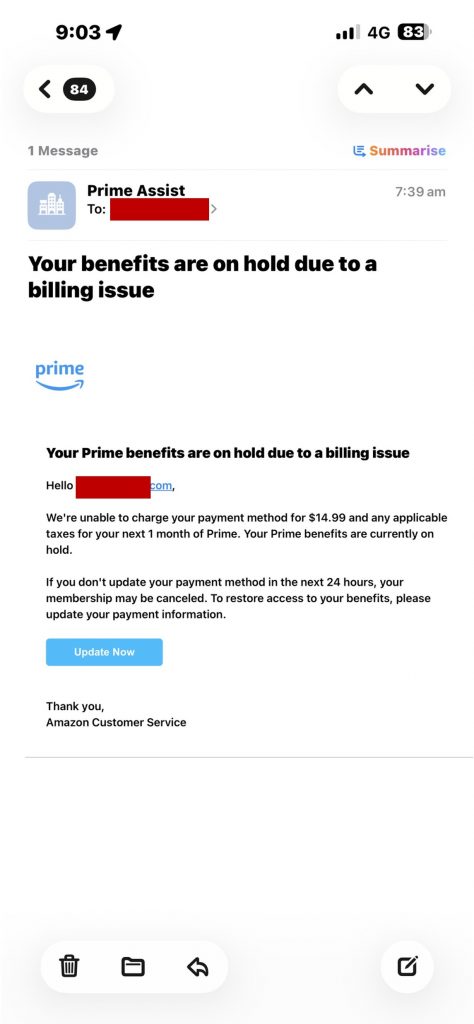
2. The “Update Now” button leads to a fake Amazon sign-in page
Tapping the button leads to a page built to look like Amazon’s real account page, designed to capture your Amazon login, personal details, and card number in a single flow rather than just one piece of information at a time.
3. Scammers walk away with your login and your card together
Because the fake page captures your account credentials and payment details in the same flow, scammers get enough to sign into your real account and place orders, not just a single stolen password. Reports from later in the year describe this flow getting more elaborate, not less, so this isn’t a one-off email that disappears after Prime Day.
Red flags
All three scams lean on the same handful of tells, whether the message is a job offer, a package alert, or a billing email.
- An unsolicited job offer with pay before you’ve worked a day: Real employers don’t recruit by cold text and don’t promise fixed daily pay for vague tasks.
- A request to move the conversation to WhatsApp or Telegram: Legitimate employers don’t need to leave your phone’s regular messaging app to talk to you.
- A deposit required to “unlock” money you supposedly already earned: A real paycheck is never gated behind a payment from you first.
- A request to reply “Y” before a link works: This is a filter-evasion trick, not a verification step any real sender needs.
- A delivery or billing link asking for payment or card details: Carriers reschedule deliveries without charging you to do it, and Amazon doesn’t need your full card number re-entered through an email link.
- Urgency tied to a deadline measured in hours: All three push for action within 12-24 hours, which doesn’t match how real HR teams, carriers, or Amazon’s billing system operate.
- A sender you can’t verify through the official app or site: Amazon’s actual job listings are on amazon.jobs. Carrier delivery status is in their own app or site, and your real Prime payment status is in your Amazon account, not a text or email link.
How to stay safe
- Don’t reply to or tap links in unsolicited job, delivery, or billing messages. Go directly to the official site or app instead.
- Check real Amazon openings at amazon.jobs, not through a text message.
- Track packages directly in the carrier’s app, using the tracking number from your original order confirmation.
- Check your Prime membership and payment status by logging into amazon.com directly, not through a link in an email.
- Use Trend Micro ScamCheck to check a suspicious text, email, or link before you respond.
- Never pay a deposit or fee to receive money you supposedly already earned.
- Report the message. In the US, report to the FTC at ReportFraud.ftc.gov. In the UK, report to Action Fraud at actionfraud.police.uk.
These scams are timed deliberately around Amazon’s own sale calendar, which is exactly what makes them feel current and believable. Even careful, tech-savvy people encounter messages like these, because the job offer, delivery alert, or billing email arrives right when a real one would. Take a moment to verify through the official app or site before you reply. Trust your instincts when pay, a package, or your account comes with a deadline attached.
0 Comments
You Might Also Be Interested In...


